euangelion.AI executive · 20–28 October
Edition
36 stories
THE EDITION

AI executive · 20–28 October

36 stories found
05

Artificial intelligence

New tools, considered

29 stories
Model economics

GPT-6.1 Terra lowers the price of capable agent work

OpenAI’s October 26 release gives teams a cheaper model for coding and computer use, with independent tests supporting the cost case and safety evaluations still showing failures.

Read 9 sources · 1 min

Horizontal bars on a common $0–$1.50 scale show GPT-5.6 Terra at $1.40 per task and GPT-6.1 Terra at $0.40. These are evaluator task costs, not guaranteed production bills.

Cost on the same task suite

AA’s October 26 evaluation, maximum reasoning effort.

USD per task

USD per task
GPT-5.6 Terra$1.40
GPT-6.1 Terra$0.40

Intelligence Index v4.3.2 workload; v5 costs are not interchangeable. Customer task costs vary.

Models and measurement

Kimi K3.1 Pro arrives hosted as a harder index redraws the model gap

Kimi K3.1 Pro is available through hosted services, with weights promised by November 4; a revised independent benchmark puts its performance and the downloadable-model gap in a different light.

Read 9 sources · 1 min

Comparable bars show Opus 5.5 max 58, Kimi K3.1 Pro 46, DeepSeek V4.1 Flash 1017 max 32 and GLM-5.3 max 32. Labels distinguish hosted or promised weights from released weights.

One index; two release states

Artificial Analysis Intelligence Index v5, October 27.

AA Intelligence Index v5

index points
Claude Opus 5.558

Hosted · max effort

Kimi K3.1 Pro46

Weights promised

DeepSeek V4.1 Flash 101732

Weights released · max

GLM-5.332

Weights released · max

A changed benchmark is not a model regression. Kimi weights are promised; no universal task ranking is implied.

Models you can run

New downloadable models widen local choice, with very different commercial terms

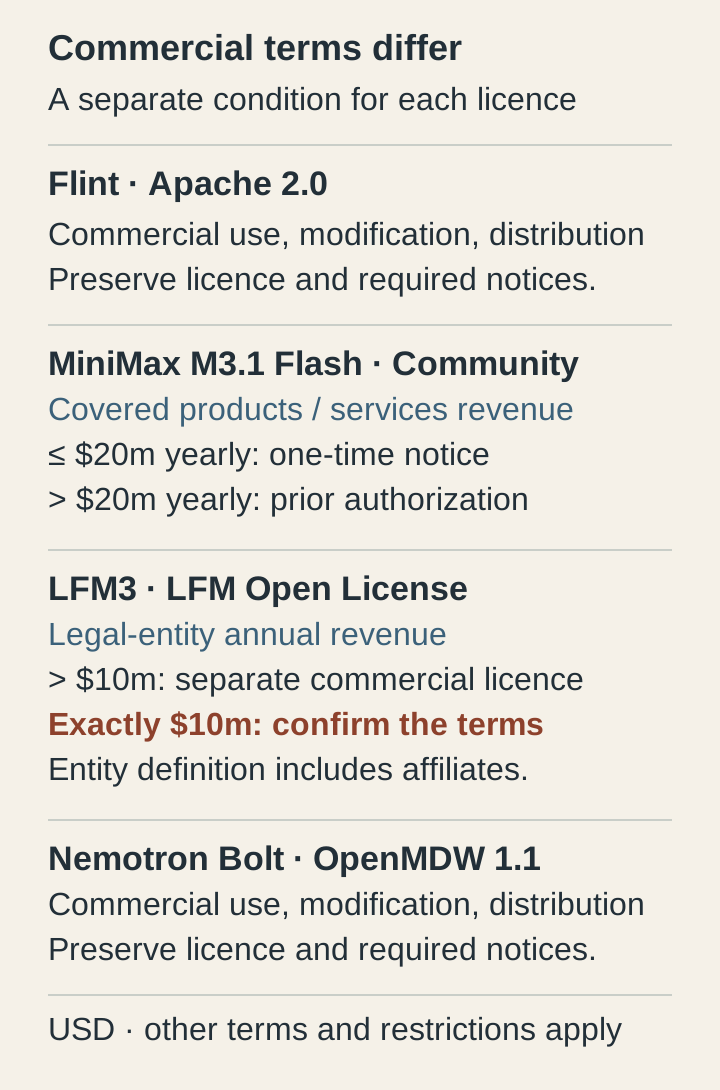
Flint, MiniMax M3.1 Flash, Liquid’s LFM3 and NVIDIA’s Nemotron Bolt add self-hosting options, but hardware needs and licence conditions make them distinct purchasing decisions.

Read 13 sources · 1 min
Categorical licence comparison: Flint and Nemotron Bolt permit commercial use under their notice terms; MiniMax uses covered products/services revenue for its $20m notice-versus-authorization boundary; Liquid uses legal-entity revenue and its exact $10m boundary needs confirmation.
Each licence measures its own conditions. MiniMax uses yearly revenue from covered products or services; Liquid uses the legal entity, including affiliates. Liquid’s exact $10m boundary is inconsistent in the source and needs confirmation. Other terms still apply.
Capital spending · Financing

Meta pairs $34.9 billion of quarterly capital spending with a $37.5 billion offering

Meta reported negative $2.12 billion free cash flow for Q3 and priced $25 billion of common-stock forward sales plus $12.5 billion of preferred shares; the offerings were expected to close October 29, with common-stock proceeds arriving only on later settlement.

Read 5 sources · 1 min

Meta Q3 2026 matched bars: operating cash flow $32.79 billion; capital spending including finance-lease principal $34.91 billion.

Quarterly cash generation and capital spending

Capex exceeded operating cash flow by $2.12bn.

Meta · quarter ended September 30, 2026

US$ billion
Operating cash flow$32.79bn
Capital spending$34.91bn

Meta’s Q3 2026 definitions; capex includes finance-lease principal. Free cash flow is non-GAAP.

Compute finance · Conditional commitment

SpaceX announces a conditional commitment for a roughly $40 billion GPU lease

SpaceX says an Apollo-managed entity has committed to an approximately $40 billion GPU finance lease, with closing conditions still outstanding and equipment deliveries and lease starts expected in the first half of 2027.

Read 3 sources · 1 min

SpaceX lease milestones: binding commitment October26 2026; conditional closing expected by year-end; deliveries and lease starts expected in first-half2027.

From commitment to equipment

UTC calendar position only; no closing time inferred

Delivery follows a conditional closing.

Binding commitment26 October 2026
Expected closingBy year-end 2026
Expected deliveries and lease startsFirst half of 2027
26 Oct 202630 Jun 2027

Expected milestones from the October26 release; not completed transactions or installed capacity.

Infrastructure · Manufacturing bottlenecks

AI supply expansion reaches packaging, memory contracts and factory-built data centers

NVIDIA’s manufacturing plans and SK hynix’s long-term memory agreements show capacity being secured years ahead, while NVIDIA’s promised 14-day modular installation applies only after a site’s supporting infrastructure is ready.

Read 5 sources · 1 min

SK hynix Q3 comparisons in trillion won: revenue24.4489 in2025 and104.6155 in2026; operating profit11.3834 and83.3338.2026 figures preliminary.

Memory demand reaches supplier results

Q3 revenue and operating profit rose sharply year over year.

Revenue

KRW trillion
Q3 202524.45
Q3 2026104.62

Operating profit

KRW trillion
Q3 202511.38
Q3 202683.33

SK hynix preliminary unaudited consolidated K-IFRS figures. KRW trillion; no currency conversion.

Cloud capacity · Availability

Oracle adds live Vera Rubin capacity while planning TPU and Cerebras access for 2027

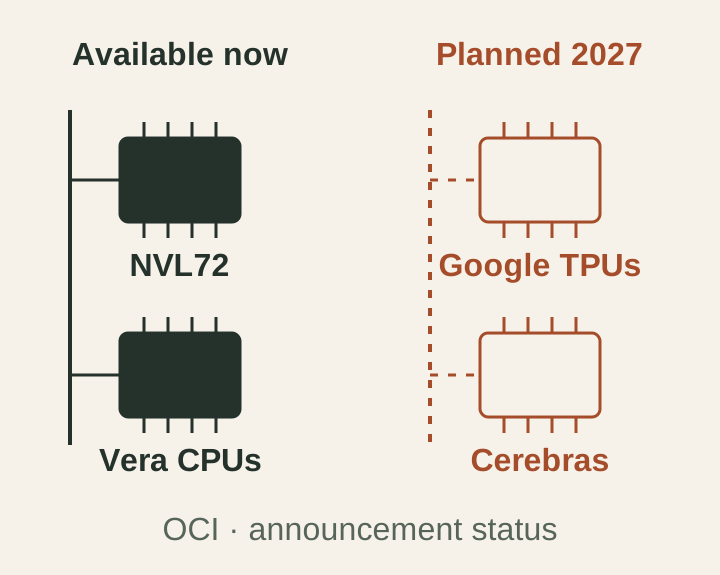
Oracle and NVIDIA announced general availability of Vera Rubin NVL72 and Vera CPUs on OCI, while Google TPUs and Cerebras inference on OCI are planned for 2027 and the larger multi-gigawatt Rubin expansion remains a plan.

Read 4 sources · 1 min
Two OCI availability rails: solid now rail for NVIDIA Vera Rubin NVL72 and Vera CPUs; dashed2027 rail for planned Google TPUs and Cerebras.
Vera Rubin NVL72 and Vera CPUs are generally available on OCI. TPUs and Cerebras are planned for 2027; customer inventory still needs confirmation.
Open infrastructure · Serving software

TorchTPU and llm-d 1.0 make a portable inference stack more practical

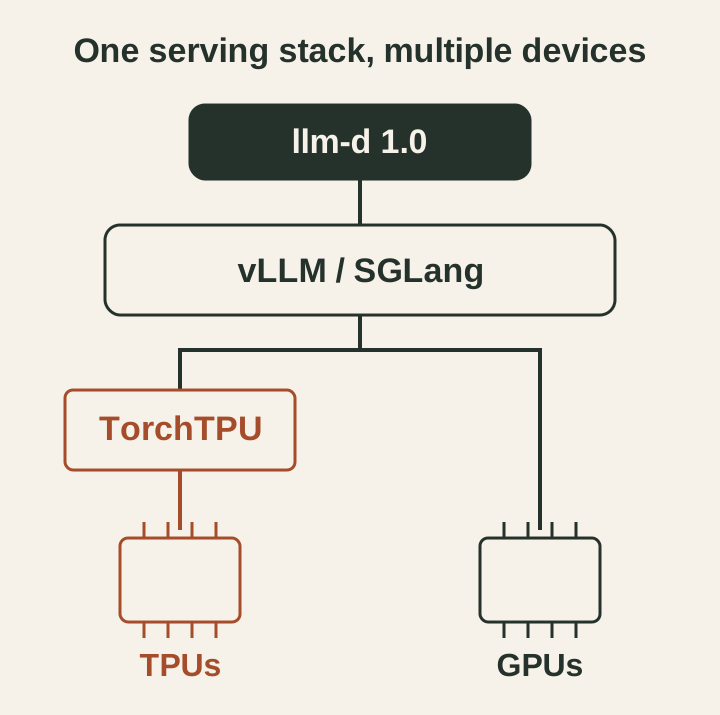
The October 20 TorchTPU, vLLM/SGLang and llm-d 1.0 releases connect native PyTorch on TPUs with distributed serving controls, reducing migration work while leaving numerical correctness, model coverage and production economics to workload-specific validation.

Read 8 sources · 1 min
Software layer diagram: llm-d routes to vLLM/SGLang serving engines. One branch passes through TorchTPU to TPUs; another uses GPU backends. Schematic, not a performance comparison.
TPU plugins add a hardware path beneath familiar serving engines; llm-d manages requests above them. Compatibility still depends on model and configuration.
Adoption · Work and employment

AI use is broadening; the employment evidence needs a separate reading

New usage data, a large Uber rollout and employment research reveal different parts of workplace change, without establishing that AI caused the reported staffing trends.

Read 10 sources · 1 min

Two 100-percent bars show the average top-ten activity share declining from 56.0 percent in Q1 2025 to 51.1 percent in Q3 2026 across 74 countries observed every quarter. Remaining shares are calculated as 100 minus those values.

Work use becomes less concentrated

Average across 74 continuously observed countries

Q1 2025

percent of classified work messages
  • Top ten activities56.0%
  • Other activities44.0%

Whole: 100 percent of classified work messages

Q3 2026

percent of classified work messages
  • Top ten activities51.1%
  • Other activities48.9%

Whole: 100 percent of classified work messages

Individual ChatGPT plans only. Message mix does not measure productivity.

Platform policy · November 20

OpenAI sets a November 20 approval requirement for model-access intermediaries

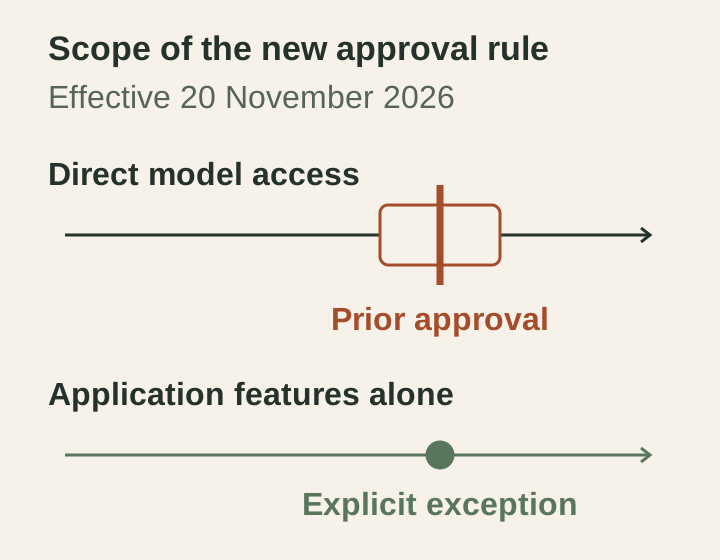
OpenAI’s updated usage policies require prior review and approval for services that give third parties direct model access from November 20, while excluding applications merely because they use OpenAI models to power features.

Read 3 sources · 1 min
Two paths under OpenAI's November20 policy: direct model access crosses a prior-approval gate; an application's use of models solely for its own features has an explicit exception.
Direct model-access intermediaries need prior approval from November 20. Applications using models solely for their own features are excepted.
Public-sector procurement · Usage pricing

GSA’s Claude agreement shifts the purchasing question from seats to usage

Eligible US governments can obtain a 40% token-usage discount with no minimum order under GSA’s expanded Claude agreement.

Read 3 sources · 1 min

Two zero-based bars show a normalized token list-price basis of 100 and a price of 60 after the stated 40-percent discount, holding the eligible model and token basket fixed. This is illustrative arithmetic, not measured operating-cost savings.

A lower price for eligible token use

Same eligible model and token basket

Eligible token-price comparison

normalized price units; list price = 100
List-price basis100
After 40% discount60

Illustrative price arithmetic, not total cost savings. Eligibility and cloud timing apply.

06

Biotechnology × AI

At the edge of what we know

5 stories
Drug development · Laboratory and document evidence

AI drug-development reports show progress at specific bottlenecks

Anthropic’s partners report laboratory improvements and faster manufacturing-record review, with clear gaps between these early results and successful medicines.

Read 3 sources · 1 min

Zero-based bars compare 1,553 minutes of unaided internal review with 166 minutes for processing plus human checking of model comments, across four batch records totaling 1,061 pages.

Time to review four batch records

1,061 pages from one manufacturing campaign

Logged internal review time

minutes
Unaided internal review1,553
Processing + human check166

Exploratory company study. Processing still includes human checking.

Public research · Biosecurity

UK backs an AI Biosecurity Lab with public funding and model access

The UK announces £100 million in government funding alongside up to £200 million in company support, largely credits, access and technical assistance.

Read 2 sources · 1 min

Separate groups distinguish £100 million in announced UK government funding from £100 million of OpenAI credits and access, and up to £100 million of Anthropic credits, access and support.

Public funding and company support

Announced commitments to the UK lab

Government funding

GBP millions announced
UK government£100m

Company commitments

GBP millions stated value
OpenAI credits + access£100m
Anthropic credits + supportUp to £100m

Upper commitment; includes model access and technical support.

Credits, access and support are not cash funding; commitments are not spending.

Open models · Experimental validation

Protein-design tools broaden access; binding remains an early result

RFD4-Proteina’s public launch expands access to protein design, while a separate Claude study reports 17 binding hits without demonstrating toxin neutralization.

Read 6 sources · 1 min

Two equal-total strips show 180 agent-selected candidates plus 31 human-assisted additions comprising 211 tested designs, and 17 designs meeting binding criteria versus 194 not meeting them. Binding is not neutralization, and the experiment is separate from RFD4-Proteina.

Selected designs and measured binding

Anthropic's separate 211-design experiment

Candidates sent to testing

designs
  • Agent-selected candidates180

    Campaign included human follow-up prompts.

  • Human-assisted additions31

Whole: 211 designs

Study binding criteria

designs
  • Met binding criteria17

    Two hits were measured at one laboratory only.

  • Did not meet criteria194

Whole: 211 designs

Human steering and additions included. Binding was measured; neutralization was not tested.

Discuss in your voice app

Take the reporting, visual explanations and original sources into a conversation. Copy the brief, paste it into your preferred assistant, then start its voice mode.

Open ChatGPT
Paste the brief into your voice app to discuss this reporting.