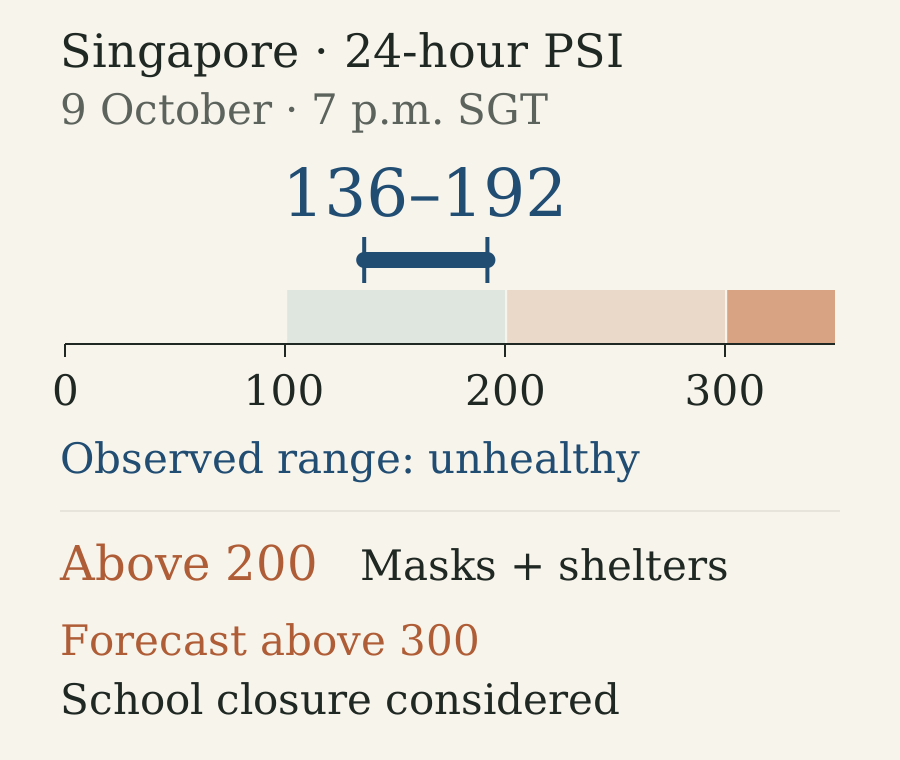
Singapore’s 24-hour PSI ranged from 136 to 192 at 7 p.m. SGT on October 9. Above 200: masks for eligible people and shelters; next-day forecast above 300: school closure considered.
Atrial-fibrillation C-index with 95% confidence intervals from Table 5. Emory: clinical covariates, 0.70 (0.69–0.72); clinical covariates plus AI, 0.75 (0.73–0.77). Beth Israel Deaconess: clinical covariates, 0.77 (0.75–0.79); clinical covariates plus AI, 0.81 (0.79–0.84). Both use a 0–1 scale. Same-study retrospective results; concordance is not percentage accuracy, risk reduction or demonstrated patient benefit.
Atrial-fibrillation risk ranking
Table 5 reports higher concordance when the AI score joins clinical covariates at both outside hospitals.
Emory
C-index
Clinical information0.70
95% CI 0.69–0.72
Clinical + AI score0.75
95% CI 0.73–0.77
01
Beth Israel Deaconess
C-index
Clinical information0.77
95% CI 0.75–0.79
Clinical + AI score0.81
95% CI 0.79–0.84
01
One retrospective study. Confidence intervals are 95%; C-index is risk/event ordering, not accuracy, risk reduction or patient benefit. Outcome-specific exclusions apply.
Discuss in your voice app
Take the reporting, visual explanations and original sources into a conversation. Copy the brief, paste it into your preferred assistant, then start its voice mode.